CHARACTERISTICS

Segmented worms make up the Phylum Annelida. The phylum includes earthworms, leeches, and a large number of mostly marine worms known as polychaetes.

Polychaetes (meaning "many bristles") have many bristles on the body, while earthworms and leeches have fewer bristles.

Some are parasitic, as the leeches; others filter-feed or prey on other invertebrates. However, probably the most significant ecological role played by annelids is reworking of soil and sediments. Many polychaetes and oligochaetes are burrowers that constantly rework the sediment through which they burrow.

Annelids display bilateral symmetry, they have a soft body and withouth skeleton. They range in length from under a millimeter to over 3 metres

They are found in most wet environments, and include many terrestrial, freshwater, and especially marine species (such as the polychaetes).

There are about 9,000-10,000 species of annelid known today.

earthworm animated gif
tube of polychaete


Tube of a polychaete


ORGANIZATION


The body of Annelids is formed by a ring succesion or segments. For this reason we say that Annelids are segmented worms. Segmentation is also called metamerism.


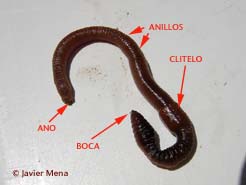
Is not easy to distinguish parts in the body of an annelid. If we took like example the earthworm, we will see that it is formed by a ring succession, with a tinner end where is the mouth, and another one more thickness, where the anus is situated.

Also there is a heavier part: the clitellum, that it is where the earthworm carries the eggs, which will be left in the ground.

earthworm

Earthworm

They are lacking of articulated appendices. They move by means of coordinated contractions of muscles..

Some annelids as Polychaetes have lateral expansions of the body that are used like locomotive appendices (parapods).


REPRODUCTION


Although Polychaetes usually have separate sexes, the most of annelids like earthworms and leeches are hermaphroditic with both male and female gonads in the same animal.

They have INTERNAL FERTILIZATION and they are OVIPAROUS annimals .
In terrestrial annelids like earthworms, the egg putting is deposited in the ground.
In aquatic annelids like the leech, the eggs are deposited in the water.


CLASSIFICATION

There are about 13,000 species of annelids and they are classified
according to their habitat, morphology and way of life.

Here we show a small classification to know the class to that an annelid belongs:

  Sea annelids
Class POLYCHAETES
 
  Terrestrial and freshwater annelids
Class OLIGOCHAETES
 
  Fresh water annelids (parasitic)
Class HIRUDINEA


[Home] [Characteristics] [Classification] [Test] [Worksheets]

Spanish